Motion Data

Introduction
Section titled “Introduction”Motion Data leverages geo-information-based analytics derived from anonymized signaling data obtained from Deutsche Telekom’s mobile network in Germany. These insights serve as a foundation for developing multiple use cases centered around user activity and movement. By harnessing these analytics, businesses can make informed strategic decisions regarding investments, leasing, expansion, marketing, and other critical focus areas. The data enrichment process includes information such as age groups, gender, and purchasing power, offering a comprehensive understanding of people’s movement patterns. This, in turn, supports location planning, urban development, sales, and marketing initiatives.
With over 65 million smartphone users in Germany, there is a vast amount of data available that can be refined and analyzed to extract valuable insights. T-Systems’ Motion Data solution prioritizes user privacy and complies with GDPR regulations by employing anonymization techniques. Personal details such as names, mobile numbers, and home addresses are never stored or processed, ensuring data privacy. The resulting data is transformed into robust use cases that deliver valuable insights to enterprises, enabling them to enhance customer acquisition activities, planning processes, and promotional strategies.
Customer benefits
Section titled “Customer benefits”- Strong data processing and anonymization policies developed in cooperation with Germany Privacy authorities.
- Data assets delivered via Telekom Data Intelligence Hub to ensure trustful and secure sharing on any cloud of your choice.
- Access to Motion Data either via standard products with tailor-made subscriptions, or via project-based requirements as per your needs.
- High data accuracy and reliability based on the largest and the best network in Germany: Deutsche Telekom.
- Wide range of KPIs and metrics to assist you in your data analytics and decision-making processes.
Product offerings
Section titled “Product offerings”The existing product portfolio of Motion Data comprises a range of tailored offerings designed and delivered to meet the specific requirements and business needs of individual customers. Additionally, Motion Data is actively working towards introducing standardized products in the future, catering to various use cases with limited customization, and offering affordable pricing options.
Visitor Analytics
Section titled “Visitor Analytics”Visitor analytics enables enterprises across public and private sector to view, gain insights and take informed decisions based on visitor information across any location in Germany. With historical data sliced across geography, time period & customer attributes, companies can implement better strategy for visitor to sale conversion.
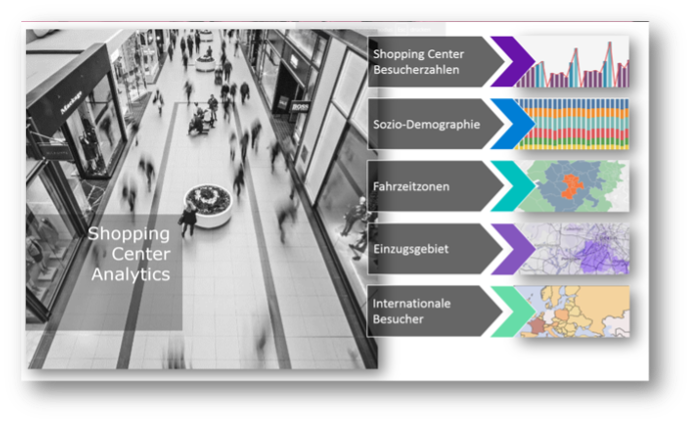
- Scope: Analysis of visitors in terms of unique number of visitors plus additional insights on gender, age, origin of visitors as well as international visitors.
- Customer benefits: Gain a deep understanding of visitation and their development over time at POIs, high streets, arenas, shopping centers or areas (own and competition), touristic hotspots or whole cities.
- Target industries: Retail enterprises, mobility, real estate, tourist businesses, traffic authorities, security, etc.
Retail Analytics
Section titled “Retail Analytics”Retail analytics empowers retail businesses by providing valuable support in comprehending customer preferences, enhancing store planning and product assortment, executing targeted marketing campaigns, and improving operational efficiency, all with the ultimate goal of boosting sales and profitability. Leveraging the principles of Motion Data, retail analytics gathers, analyzes, and interprets mobile signaling data to identify customer behavior and extract crucial insights that inform strategic decision-making.
Retail analytics can help our retailers in many different areas:
- Operations: Gain insights into the foot traffic of your store or preferred locations in order to strategically plan activities and tasks for optimizing operational efforts. Conduct analysis to optimize staff schedules, minimizing labor costs and maximizing conversions, all while ensuring an exceptional shopping experience.
- Store planning: Understand your visitor preference visit-areas and geographical coverage of high-user density and plan your brick-and-mortar presence to gain maximum visibility and high shopper footfall.
- Marketing: Promote your brand and store information by strategically placing advertisements in residential areas with underrepresented visitors’ penetration or above-average presence of the preferred target customer group. Develop well-planned marketing campaigns to maximize the visibility of your ads and effectively target your preferred customer groups.
- User analytics: Determine the origin of your customers and the demographic groups you can attract to your preferred locations. This information allows for an assessment of customers’ purchasing power and how far they are willing to travel for their shopping experience. This further helps in product assortments and store planning.
- Comparison and benchmark
- Competitor analysis: Retail Analytics allows you to not only monitor your own assets but to compare the visitation behaviour and the sociodemographic structures against the visitors of competing shopping centers and/or high streets in the vicinity.
- Trends: Analyze trends and time series to react to change / development in shopping behaviour (recent changes due to home-office etc.).
Traffic Analytics — Origin–Destination Matrix (ODM)
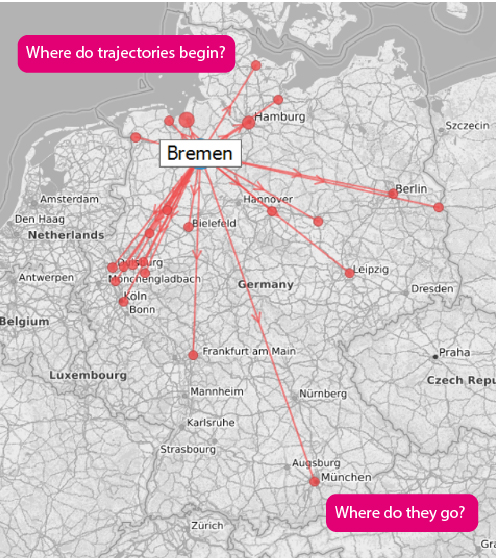
Section titled “Traffic Analytics — Origin–Destination Matrix (ODM)”The ODM (Origin-Destination Matrix) product is utilized for analyzing and visually representing the movement and flow of individuals between various origins and destinations. It offers a comprehensive understanding of travel patterns and the interactions occurring within specific locations.
- By utilizing the location information available in the mobile signaling data, the ODM product determines the position of participants. The timing of their movements and pauses (activities) plays a crucial role in this process.
- The identification of movements (trips) relies on the duration of pauses between two consecutive movements, requiring a minimum stay of 10 minutes.
- Trips are defined by their start point (origin) and endpoint (destination), allowing for a clear delineation of travel paths.
POI near real-time (Points of Interest)
Section titled “POI near real-time (Points of Interest)”Near-real-time Point of Interest (POI) analytics deliver detailed insights on various locations across Germany with minimal delay. Businesses can leverage such analytics to observe immediate visitation behaviors. These kinds of datasets can be used for DOOH (Digital-Out-Of-Home), traffic- and visitor analytics.
Features and benefits
Section titled “Features and benefits”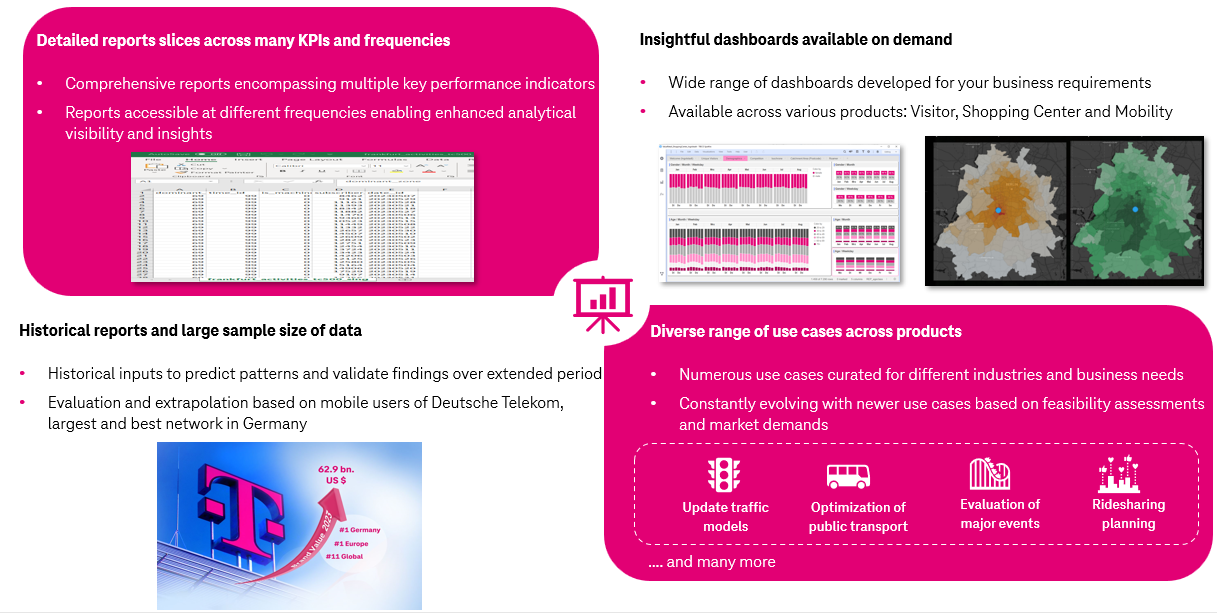
Key use cases
Section titled “Key use cases”| Use case name | Challenges | Solution | Customer benefits |
|---|---|---|---|
| Public transport optimization in rural areas |
|
|
|
| Business planning ridesharing |
|
|
|
| Major events evaluation |
|
|
|
Guides
Section titled “Guides”Understand and use the Motion Data reports and products:
- Getting started — standard geometries and spatial resolution basics.
- Visitor Analytics — read and use a Visitor Analytics report.
- Traffic Analytics — read and use a Traffic Analytics (ODM) report.
- Traffic Analytics on statistical week — the ODM product on statistical-week resolution.
- Order Visitor Analytics Pro — self-service ordering via the DIH Portal.
Reference
Section titled “Reference”- Product documentation — index of Motion Data usage guides.
- FAQs — frequently asked questions about Motion Data.
Contact details
Section titled “Contact details”Production documentation: Motion Data.